What Algorex Combo Lab shows
What Algorex Combo Lab does and what it shows on your chart.
Written By Algorex Trading Support
Last updated About 14 hours ago
Every trading idea sounds convincing. The question is whether it holds. Algorex Combo Lab is a free laboratory for the MetaTrader Strategy Tester: pick one entry block, switch on any mix of filters, choose your exits, run the test and read the lab report.
Entry blocks (pick one)
Breakout of the last N bars
Break of the last fractal
Moving-average cross (EMA)
RSI reversal
Fixed time of day
Opening range breakout
Break of the previous day's high or low
Random entry: the baseline every idea has to beat
Every block can be followed or faded, traded long and short or on one side only.
Filters (any mix)
Trend: only with the EMA of a higher timeframe
Volatility: only when the ATR is at or above its median
Session hours (server time), no new trades on Friday, maximum spread, maximum trades per day
Exits and size
Stop by ATR, fixed points or behind the last swing; the stop distance is 1 R
Target in R, break-even, ATR trailing stop, time exit, opposite signal, session end
Fixed lots or risk in percent of the balance
The lab report
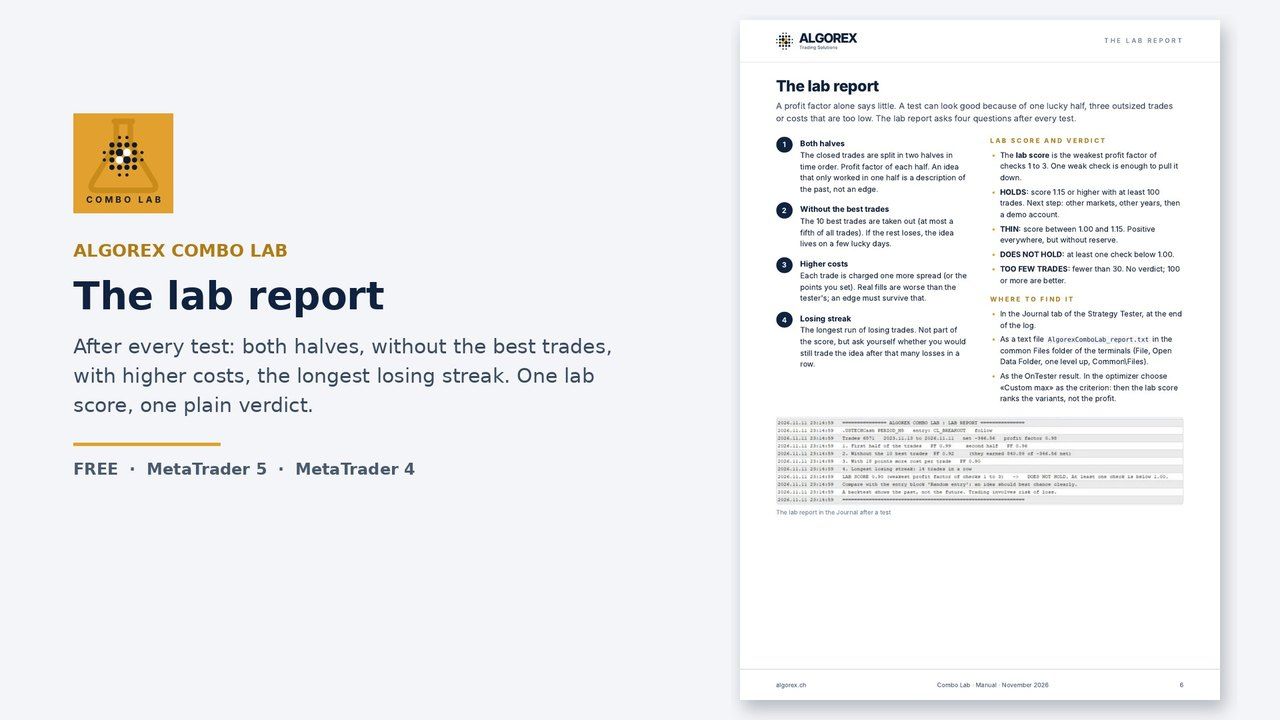
After every test the Journal shows four checks: the profit factor of both halves of the test, the result without the 10 best trades, the result with one more spread of cost per trade, and the longest losing streak. The weakest profit factor of the first three is the lab score, with a plain verdict: HOLDS, THIN, DOES NOT HOLD YET or TOO FEW TRADES.
The scoreboard
All eight entry blocks run side by side in every test, with the same filters, exits and costs, and are ranked by lab score in the panel (button Scoreboard) and at the end of the lab report.
How to use it
Open the Strategy Tester and choose Algorex Combo Lab.
Pick one entry block and run the test (MT5: 1 minute OHLC; MT4: every tick).
Read the lab report at the end of the Journal.
Change one thing at a time and compare, always against the random entry.
A laboratory for testing ideas, not a finished system. No setting is a recommendation, and the default settings are a starting point. A backtest shows the past, not the future.
Where to get it
MetaTrader 5: mql5.com/en/market/product/208371
MetaTrader 4: mql5.com/en/market/product/5605
Was this helpful?
Still need help? Share an idea